Showing posts with label history. Show all posts

Monday, January 26, 2009

Ten Things You Might Already Know About Me


My first name comes from a doll in a Beatrix Potter story, "The Tale of Two Bad Mice."

I began ballet lessons as an adult. I had foot surgery and needed to strengthen my foot and keep it flexible. It kept the rest of me strong and flexible too. I was the only one in class with discernable breasts and hips. The others all lived on bullion and hot tea. How sad!

I am an avid herb gardener. I'm good with fruit trees too. For some reason, vegetables scare me a little. I'm growing them anyway.

My first job, with a paycheck, was School Crossing Guard. It paid a dollar a day. Doing this job, on the windswept prairie, was pure misery in the winter. I never complained or quit. I bought savings bonds with my money and vowed never to allow myself to be that cold again.

I have always gotten along well with my parents, even as a teenager.

I learned American Sign Language as a child. I wouldn't say I'm all that fluent at this point because I have no one with whom I can converse. The little town I grew up in was very near a state school for the deaf and when I was very young, several of the school's students lived in that town. We played together in the summer. I, and other "hearing" children who attended the public school, drove our teachers crazy by signing to one another during class and study halls. They couldn't really punish us for talking, so they would move us so that we were no longer facing one another. All this came to a halt when Mrs Grell, our sixth grade teacher, moved to town. She was a hearing person raised by deaf parents. She not only understood our signing, she read lips too. Ouch!

When I write in my journal, I start in the back and end in the front. I have no idea why. Moleskine Cahier Notebooks are my favorite. When I was in elementary school, I stitched my own journals from scrap paper.

I work in the "carriage trade".

I learned to knit and hand sew before the age of three. I won't say I was immediately good at either of them.

I look like my paternal grandmother when she was younger.


Monday, December 22, 2008

"I Heard the Bells on Christmas Day..."


This Christmas Carol is based on the poem "Christmas Bells" by Henry Wadsworth Longfellow, during the American Civil War.

Longfellow had just lost his wife in a house fire and his son had been severely wounded in battle. When he stepped outside, on Christmas morning, to the sound of bells chiming, he was anguished. The world was not at peace. How could anyone ring those bells? Then he worked out his pain on paper. It's worth reading. A poem of hurt and dispair but also a poem of understanding and hope.

And isn't hope what Christmas is about?

If you would like to hear a very stirring rendition, go here.


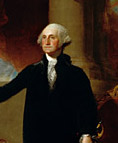
Photo: Public Domain

Wednesday, December 10, 2008

Halcyon Days


The fourteen days preceeding the winter solstice are referred to as Halcyon Days. In ancient times, the belief was that this bird, a kingfisher, nested on the sea, which it calmed in order to lay its eggs on a floating nest. For this reason, the ancients expected the weather to be calm around the winter solstice. Ultimately, the term "halcyon" came to mean calmness or peacefulness.


I mentioned previously that I'm not all that fond of winter. Still, I think these last, short days of the year are a wonderful time to reflect and look forward to lengthening days and more sunshine. I am a Christian, but I observe the solstice as well. I see no conflict here. Rather, it is another way of marking time and remembering to be grateful for all the wonderful gifts we have in the natural world.


photo licenced by david meeker

Thursday, November 27, 2008

New York, 3 October 1789


"By the President of the United States of America, a Proclamation.
Whereas it is the duty of all Nations to acknowledge the providence of Almighty God, to obey his will, to be grateful for his benefits, and humbly to implore his protection and favor-- and whereas both Houses of Congress have by their joint Committee requested me to recommend to the People of the United States a day of public thanksgiving and prayer to be observed by acknowledging with grateful hearts the many signal favors of Almighty God especially by affording them an opportunity peaceably to establish a form of government for their safety and happiness.
Now therefore I do recommend and assign Thursday the 26th day of November next to be devoted by the People of these States to the service of that great and glorious Being, who is the beneficent Author of all the good that was, that is, or that will be-- That we may then all unite in rendering unto him our sincere and humble thanks--for his kind care and protection of the People of this Country previous to their becoming a Nation--for the signal and manifold mercies, and the favorable interpositions of his Providence which we experienced in the course and conclusion of the late war--for the great degree of tranquility, union, and plenty, which we have since enjoyed--for the peaceable and rational manner, in which we have been enabled to establish constitutions of government for our safety and happiness, and particularly the national One now lately instituted--for the civil and religious liberty with which we are blessed; and the means we have of acquiring and diffusing useful knowledge; and in general for all the great and various favors which he hath been pleased to confer upon us.
and also that we may then unite in most humbly offering our prayers and supplications to the great Lord and Ruler of Nations and beseech him to pardon our national and other transgressions-- to enable us all, whether in public or private stations, to perform our several and relative duties properly and punctually--to render our national government a blessing to all the people, by constantly being a Government of wise, just, and constitutional laws, discreetly and faithfully executed and obeyed--to protect and guide all Sovereigns and Nations (especially such as have shewn kindness unto us) and to bless them with good government, peace, and concord--To promote the knowledge and practice of true religion and virtue, and the encrease of science among them and us--and generally to grant unto all Mankind such a degree of temporal prosperity as he alone knows to be best.
Given under my hand at the City of New York the third day of October in the year of our Lord 1789.
Geo: Washington"


Just in case you've never had the priviledge of reading it.....

Sunday, November 23, 2008

Get out of town!


I like to take mini-vacations. There are so many interesting sites not far away. I think this is probably true of most cities. I can usually find something worth exploring within an hour's driving distance.

I have been watching my friends' home, and animals, about twenty-five miles south of Omaha. Ten miles south of her home is the frontier town of Plattsmouth. There is so much history there. I visit there regularly and still have not see all of it. An important site on the Lewis and Clark Trail, Plattsmouth boasts a wonderful Main Street. It's original buildings house an old fashioned hardware store, an amazing quilt shop, a wine shop which stocks local vintners' wares, a restaurant called "Mom's" which serves up comfort food and a quaint atmosphere, and much more.

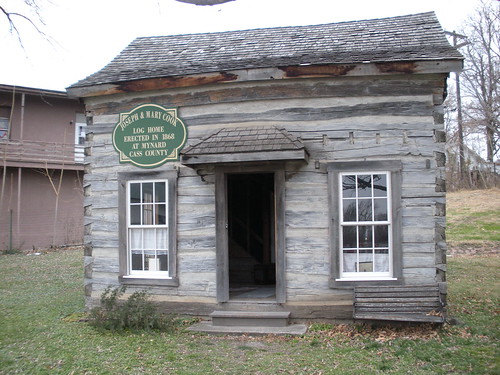
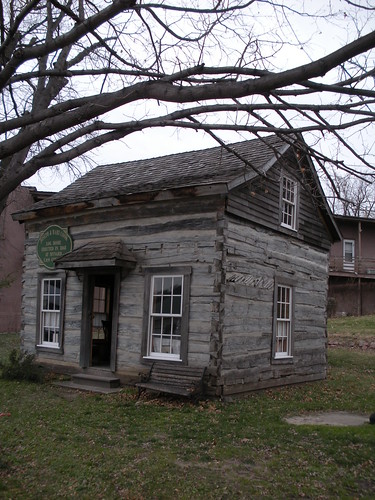
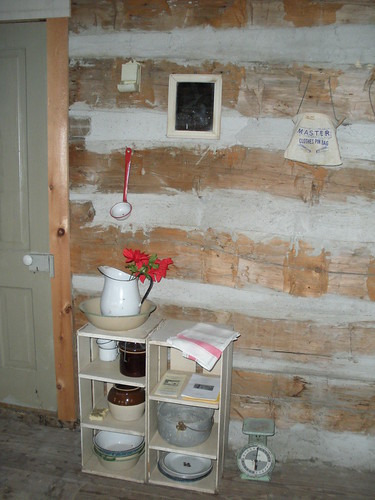
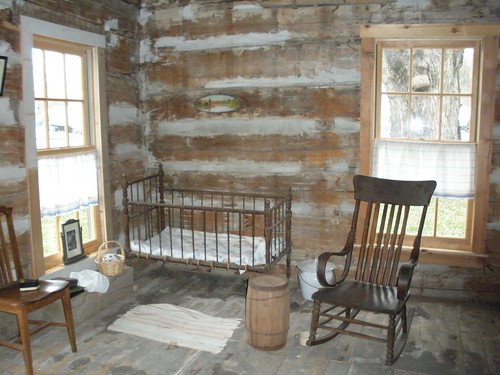
Just two blocks east of Mom's, near the Burlington Rail Lines, I found the Cook Cabin. Del Hervey, a member of the Cass County historical society, was just locking the cabin and a restored caboose, for the winter, when I arrived. I didn't want to bother him and thought I'd just snap a few pics before heading toward the toll bridge to get some pictures of the river. But Del, in spite of the chilly weather, was enthusiastic about showing me around.

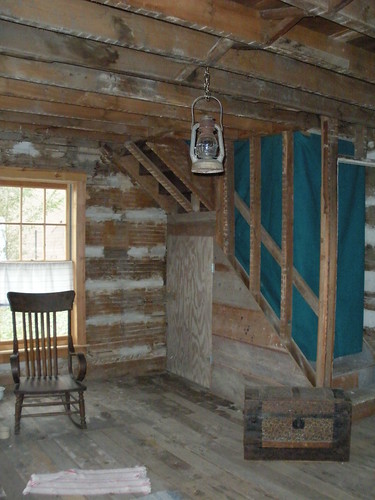
The cabin was built by German settlers, Joseph and Mary Cook (originally Koch) in 1868. It was their second home. The first was even smaller. The main floor is roughly the size of my guest bedroom but the Cooks raised eleven children to adulthood under this roof. Diaries and letters from family members indicate children slept downstairs until they were walking and "trained" and then moved upstairs, to the sleeping loft, with their older brothers and sisters.
The Cook family was on friendly terms with the Native Americans who also lived in the area. They did find it a little odd when their neighbors entered without knocking and helped themselves to whatever food was on the table.
The cabin was moved from its' original site, five miles away, to the edge of the city. Later generations had added on and eventually engulfed the cabin in a bigger farmhouse. That farmhouse was painstakingly peeled away until the cabin was once again freestanding. Historical Society members are not quite finished restoring it, but have done a wonderful job.